


People Are Still Spending… Carefully
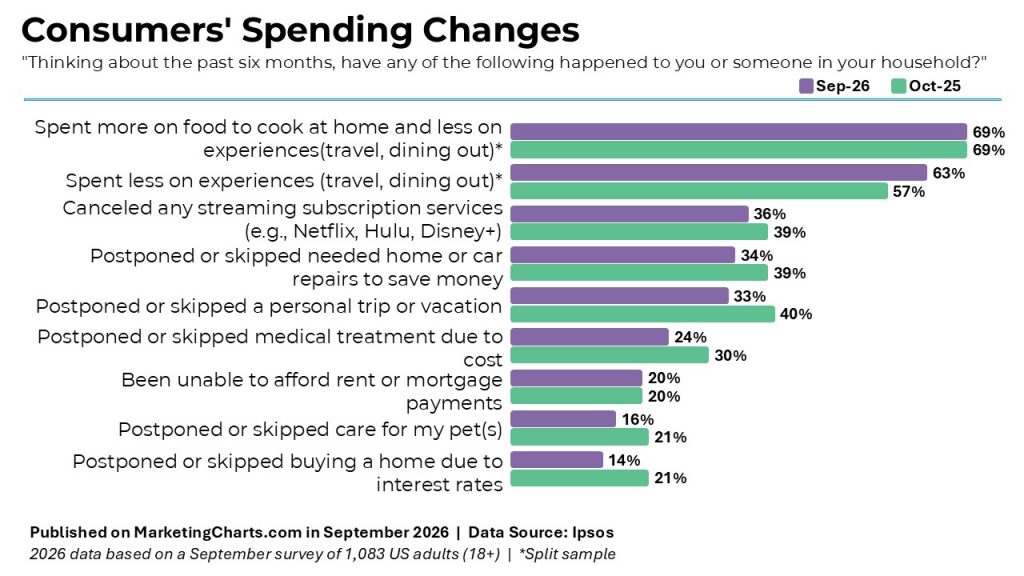
They’re still watching their wallets, but consumers aren’t pulling back as much as they were a year ago. Fewer people say they’ve canceled a streaming service, postponed a vacation, put off home or car repairs, or delayed medical care. Even the share of people putting off buying a home fell from 21% to 14%. What’s also changing is how people spend. Nearly 7 in 10 say they’re spending more on food at home and less on things like dining out and travel, while 82% say brand names are becoming less important when shopping for clothes. A great opportunity for marketers who can put forth a convincing case for value. (Ipsos via Marketing Charts: October 6, 2026)
Holiday Advertisers to Increase TV Investments
When it comes to holiday purchases, TV and streaming are the most influential advertising channels marketers are putting more money behind them. Yahoo DSP research finds that 58% of advertisers plan to increase CTV spending this holiday season, up from 45% last year, while 90% expect to use high-impact formats such as pause, first-position, and interactive ads. That comes as holiday ad budgets overall are getting bigger and starting earlier: 55% of advertisers plan to spend more this year, up from 44% in 2025, and pre-Labor Day campaign launches have doubled. But reaching shoppers is only half the battle. With 79% of consumers saying they are influenced by good deals, we may see more commercials with value-driven messaging, rather than the usual warm-and-fuzzy seasonal storytelling. (Advanced Television: September 30, 2026)
Postseason Baseball Scores Big for NBC
After 25 years without baseball rights, NBC’s return to the MLB postseason is off to a great start. Game 1 of the Red Sox-Yankees Wild Card series averaged 7.3 million viewers across the network and Peacock, up 12% from the comparable game last year and the biggest audience for a Wild Card or Division Series Game 1 on any network since 2006. Even the afternoon Phillies-Braves game drew 3.9 million, up 15% and the largest audience ever for an afternoon Wild Card Game. It’s already been a strong season for NBC, where Sunday Night Baseball averaged 2.7 million viewers, its best showing since 2007. Big-time sports on broadcast television still gather a huge audience, even with plenty of other leagues competing for viewers. (Front Office Sports: October 2, 2026)
Emmys Deal Gives Sponsors a More Permanent Home
The Emmys’ move to Amazon means more than just a change in where viewers watch the show. For years, the program had rotated among ABC, CBS, Fox, and NBC, which meant the Television Academy essentially had to start over with a different network, sales team, and group of sponsors each year. Beginning in 2027, the Emmys will have a single home on Prime Video for six years, giving Amazon and the Academy a chance to build longer-term relationships with advertisers instead of reinventing the sponsorship package each season. That continuity could open the door to bigger, more ambitious integrations that extend well beyond the telecast itself. (NYT: October 6, 2026)
This Week In Video History
October 11, 1975 – Live from New York
In 1974, Johnny Carson asked NBC executives to stop airing Saturday night reruns of his (then 90-minute) Tonight Show. The network, eager to please its biggest star, agreed and found itself with an hour and a half of time to fill each week. By February 1975, NBC was actively developing a new Saturday night show, and that October, NBC’s Saturday Night premiered.
Oh, you’ve never heard of NBC’s Saturday Night? That was SNL’s original title, because Howard Cosell (yes, the sportscaster) had a variety show over at ABC that was called Saturday Night Live. Cosell’s show did not return for the 1976 season, and NBC was able to use the name.
Trivia: One Saturday Night Live cast member has won an Academy Award for acting. Who is it? (Find out here)
