

2026 Midterm Ad Spending Could Exceed 2024 Presidential Year
Political ad spending is ramping up quickly, reaching $6.1 billion through August 24, with the busiest part of election season still ahead. AdImpact has increased its previous estimate of $10.8 billion and now projects that $11.6 billion will be spent by Election Day. Broadcast TV continues to get the biggest piece of the pie, bringing in $3.12 billion so far. CTV and streaming come in second with $1.14 billion; digital has taken in $937 million; and $770 million has been spent on cable. Republicans have spent $2.69 billion, compared with $2.35 billion for Democrats, and independent groups have added another $1.11 billion. This would make 2026 the most expensive midterm cycle ever and even surpass the 2024 presidential election. For broadcasters, this means a lot more political dollars are still on the way. (AdImpact: August 25, 2026)
SMART TV Penetration Continues to Grow
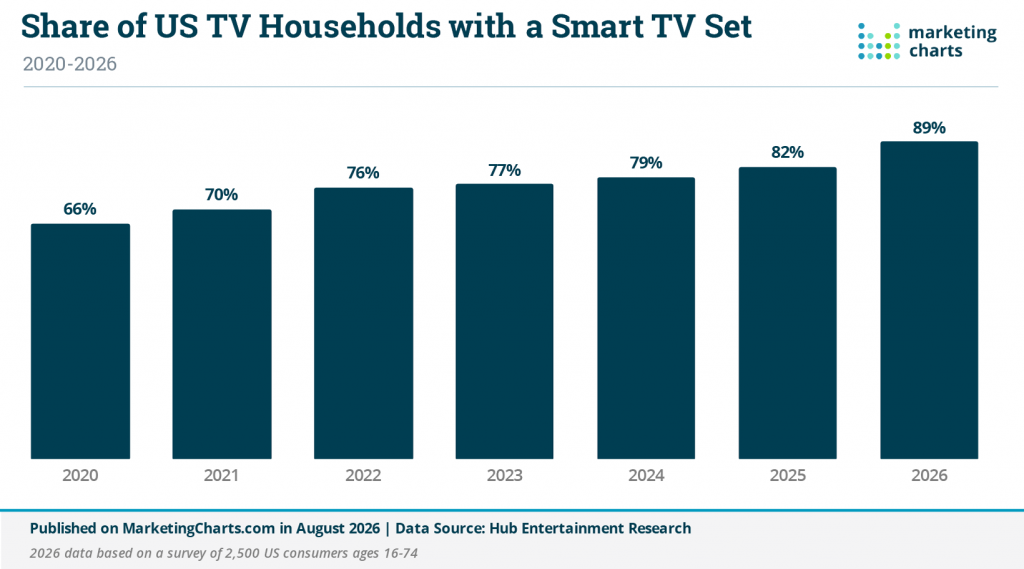
Smart TVs have become nearly universal, with 89% of U.S. TV households now owning one. That’s a sharp increase from 82% just last year. They’re also increasingly becoming the way people actually watch TV, with 69% of households using a smart TV to stream movies or shows at least once a week. The smart TV home screen is becoming more important, with 49% telling Hub Entertainment Research that it’s the first thing they see when they turn on their main TV, compared with 38% in 2024. As smart TVs go from being the norm to being all TVs, the home screen becomes increasingly valuable real estate for programmers and advertisers. (Hub Entertainment Research: July, 2026)
VIDEO’S 40-Year Generation Gap
The age gap between linear TV and creator video is striking, but it also shows just how broad the video landscape has become. Media Dynamics estimates the median linear TV viewer is 61 years old, compared with 21 for creator video, while streaming lands in the middle at 43. Linear TV is still a major part of the picture, accounting for 35% of daily TV and video viewing time, putting it ahead of streaming (33%) and creator video (26%). None of this suggests that any format is replacing another; it just shows that different generations are settling into different viewing habits, with linear still commanding a substantial share of overall viewing even as newer forms of video continue to grow. (Media Dynamics: July 21, 2026)
THE Mets Broadcast Booth Scores a Top Three Finish
The website Awful Announcing has released its annual rankings, and shows which booths fans think are getting it right. More than 9,300 fans cast over 85,000 votes, with the Padres taking the top spot for the second year in a row, followed by the Giants and Mets. The Yankees made the biggest jump, climbing from 23rd to fourth, while the Phillies rounded out the top five. Fans were a little tougher overall this year, with the average grade dipping from 2.39 to 2.25. A good broadcast team still matters, especially in baseball, where fans can spend more than 500 hours with the same voices over the course of a season. (Awful Announcing: August 19, 2026)
This Week In Video History
August 29, 1997 – The Birth of Netflix
Back when streaming video still sounded like science fiction and the retronym “physical media” had yet to be coined, there were DVDs. Netflix began as a DVD subscription service that eliminated the trip to the video store and the dreaded late fees. Subscribers would order the movies online, receive them in the mail, and send them back when they were done. Netflix discontinued DVD distribution three years ago, but it laid the groundwork for reshaping how people watch TV and movies. This commercial explains the then-new concept to consumers.
