


Summer TV Slowdown? Not This Year.
July is usually a pretty sleepy month for traditional TV, but the World Cup changed that this year. Nielsen says broadcast viewing actually rose 1% from June, rather than the typical 4-5% decline. FOX saw the biggest benefit, with viewership jumping 36% from June and the network accounting for nearly all of the month’s biggest telecasts. Cable didn’t get the same lift, largely because the number of World Cup matches airing there dropped from 31 in June to two in July. Still, Cable decreased by only 2% for the month, which was in line with expectations for that time of year. (Nielsen: September 10, 2026)
Local Political Spending in ’26 Creates an Uphill Climb in ‘27
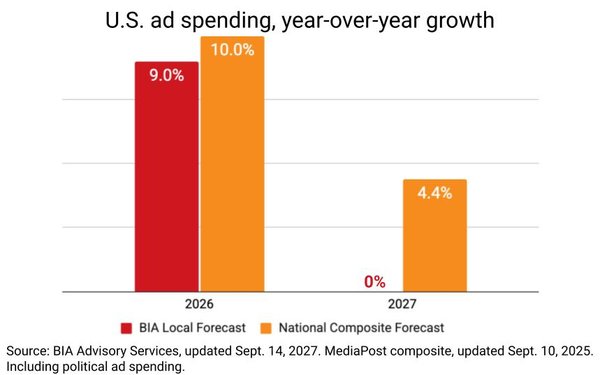
The certain-to-be record midterm spending for local media this year will be a tough act to follow in 2027, but signs are already looking positive. BIA Advisory Services expects that $9 billion in underlying, nonpolitical growth will replace the $8.6 billion year-to-year drop in political budgets, leaving total local ad revenue essentially flat. Examples: Real estate spending is forecast to grow 9.8%, leisure & recreation could see a 5.9% increase, and automotive spending is projected to be up 5.1%. Legal services are on track to continue their strong local investments as law firms rely on both linear and streaming local TV for their ability to deliver large audiences and generate leads. (MediaPost: September 14, 2026)
Hispanic Audiences Remain Heavy TV Viewers
In just the first half of this year, Hispanic audiences logged more than two trillion minutes of TV viewing across linear and streaming. Spanish-language programming was particularly strong, capturing 42% of Hispanic linear viewing, despite there being roughly nine times as much English-language content available. Traditional TV accounted for a significant portion, especially among older viewers. Hispanic adults 65+ watched nearly 45 hours of TV a week, most of it linear. Hispanic audiences are a growing part of the TV audience, and linear TV remains a major part of their viewing behavior. It remains to be seen whether this will continue throughout the rest of the year or if this was a World Cup phenomenon. (TVNewsCheck: September 23, 2026)
Increasing Competition in TV Measurement
Nielsen’s grip on TV measurement continues to loosen. The U.S. Joint Industry Committee has recertified Comscore, iSpot, and VideoAmp as national TV currencies through 2028. This means that buyers and sellers can use that data to transact on everything from total households to advanced audiences and demographic groups. This was no mere rubber-stamp approval; the certification included 672 tests and 150 million telecast observations across more than 680 networks. Nielsen still represents 80% to 90% of national TV and video transactions, but having three certified alternatives gives advertisers more ways to measure audiences and puts more pressure on the industry to prove exactly what those audiences are worth. (Television News Daily: September 22, 2026)
This Week In Video History
September 25, 1999 – Freaks and Geeks Debuts
You might think that a show whose cast included Jason Segel, Linda Cardellini, James Franco, Seth Rogen, Busy Philipps, and Martin Starr would be a massive hit right out of the gate. It might have been, except that nobody had really heard of most of them yet.
Freaks and Geeks was set in a Michigan high school in 1980. The series followed two groups of teenage outsiders and treated adolescence with a rare mix of awkwardness, humor, and genuine affection. Despite being created by Paul Feig, executive-produced by Judd Apatow, and featuring that ridiculously stacked cast, NBC canceled the show after only 12 episodes had aired. In the end, Freaks and Geeks became a cult classic that launched a remarkable number of careers.
Check out the opening credits, full of fresh-faced kids who don’t yet know that their films would go on to earn billions of dollars.
